Guides
Registered Agent: What It Is and Why You Need One
A registered agent is the person or company listed to receive official legal and government mail for your business. If you are forming a US limited liability company (LLC), which is a business structure that can separate personal and business liability, or a corporation, you will usually need one in every state where you register.
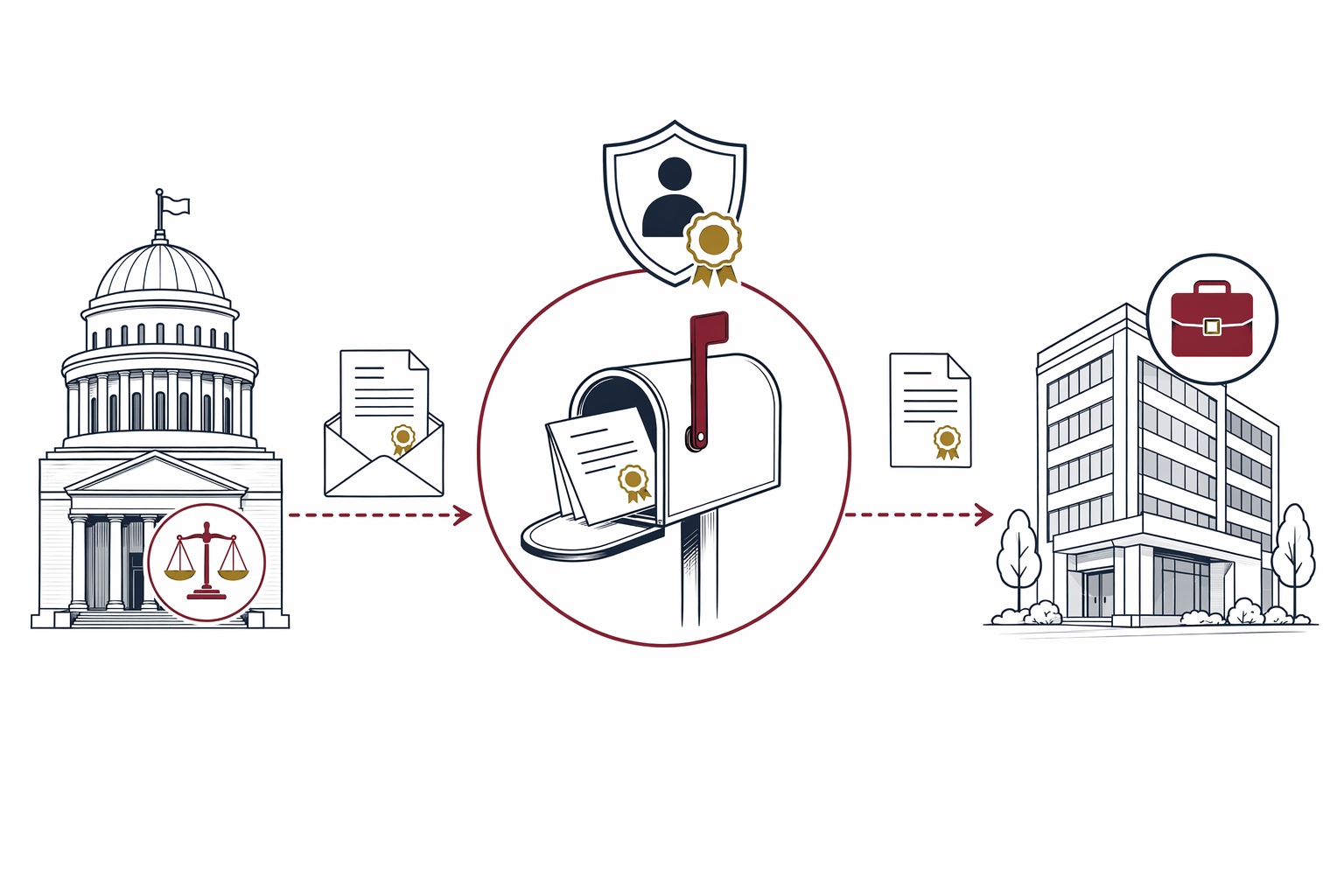
What a registered agent does
A registered agent is a person or business service that agrees to accept official papers for your company during normal business hours at a physical street address in the state. That address is often called the registered office.
The main job is simple: receive important documents and make sure you know about them quickly. These documents can include:
- state notices from the Secretary of State, which is the state office that handles business registrations
- tax letters
- annual report reminders
- service of process, which means legal papers such as a lawsuit or court summons
- compliance notices about licenses or filings
A registered agent does not run your business, make legal decisions, or replace a lawyer. The role is mostly about reliable delivery of official notices.
If you are still choosing your business structure, these guides may help: How to Form an LLC in the US, LLC vs. Corporation: Which Is Right, and What Is an EIN and How to Get One. An EIN is an Employer Identification Number from the IRS, which is the federal tax ID number for a business.
Why most LLCs and corporations need one
In most states, you must list a registered agent when you file formation documents.
For an LLC, the formation document is often called the articles of organization, which are the papers filed with the state to officially create the LLC. For a corporation, the filing may be called articles of incorporation or a certificate of incorporation, depending on the state.
States require a registered agent because the state and the public need a dependable way to reach your business for official matters. If no one can deliver legal or government notices to your company, the business can miss deadlines without knowing it.
That can lead to practical problems, such as:
- missing an annual report deadline
- falling out of good standing, which means the state no longer considers your business fully current on required filings
- default judgments in lawsuits because nobody responded in time
- delays when opening accounts, signing leases, or working with investors who want to confirm your company is active
If your business expands to another state, you may need to register there too. In that state, you will usually need a registered agent again.
This article is general educational information, not legal advice, and it does not create an attorney-client relationship. For state-specific rules, check the Secretary of State website for your state or speak with a licensed attorney.
Who can be a registered agent
In many states, a registered agent can be:
- an adult individual who lives in the state
- a business entity authorized to do business in the state and offer registered agent services
There are usually a few basic requirements:
- a physical street address in the state, not just a P.O. box
- availability during normal business hours
- consent to accept official papers for the business
You may be allowed to serve as your own registered agent if you have a real in-state address and can reliably be there during the workday. A founder, manager, officer, employee, friend, or family member may also qualify in some states if the state rules allow it.
Still, legal eligibility is not the same as practical fit. If you travel, work odd hours, move often, or do not want your address on public records, using yourself may create problems.
If your business has multiple owners, put these decisions in writing. An operating agreement is the internal document that explains how an LLC is managed, how owners make decisions, and how profits and responsibilities are handled. A founders' or partner agreement can also clarify who handles filings and notices. Learn more at Partnership and Founder Agreements.
Should you be your own registered agent
Sometimes yes. Sometimes no.
Using yourself can save money if:
- you have a stable in-state street address
- you are regularly present during business hours
- you are comfortable with that address appearing on public records in many states
- you have a dependable system for handling mail and deadlines
Hiring a service may make more sense if:
- you work from home and want more privacy
- you move often
- you travel or meet clients away from your desk
- you are registering in a state where you do not live
- you want compliance reminders and organized document scanning
A common example: a solo owner forms an LLC in her home state and lists her apartment address. That may be legally allowed. But if she later moves and forgets to update the state, a lawsuit notice or annual report reminder could go to the old address.
Another example: two co-founders form a corporation in Delaware but operate from California. They usually need a registered agent with a physical Delaware address because neither founder has one there.
If you are not sure whether your setup is practical, a licensed attorney can help you think through privacy, multi-state registration, and compliance issues. You can also learn about related legal help at Business Entity Formation and Business Compliance and Licensing.
How to choose a registered agent service
If you decide not to use yourself, compare options carefully. The cheapest option is not always the best if official notices are delayed or hard to access.
Look for these basics:
- Physical address in the right state. Make sure the service actually has a street address in the state where your business is registered.
- Reliable document handling. Ask how quickly they notify you after receiving legal papers or state mail.
- Simple access. Many services scan documents and send email alerts. Ask how records are stored and how long they are available.
- Clear annual pricing. Costs are usually a flat yearly amount, often in a state-dependent range of about $50 to $300 per year per state, but ranges are not quotes.
- No surprise add-ons. Read the renewal terms and watch for extra charges for forwarding, compliance reminders, or state filings.
- Good privacy practices. Use caution with any company that asks you to submit sensitive information through a basic website form. Usually, contact details and a short description of your need are enough to start.
You may also want help reviewing the bigger setup around your business, including contracts. An NDA is a non-disclosure agreement, which is a contract used to protect confidential information. An MSA is a master services agreement, which is a contract that sets the main legal terms for an ongoing business relationship. You can learn more at Contracts and Agreements.
How to list or change your registered agent
When you first form your business, the registered agent is usually listed on the state filing.
For an LLC, that is often part of the articles of organization. If you later need to switch agents, most states let you file a change form online or by mail and pay a filing fee. Filing fees vary by state and often fall in a state-dependent flat-fee range of about $0 to $100, but ranges are not quotes.
A simple process usually looks like this:
- Confirm the exact name and address requirements on your Secretary of State website.
- Get the new agent's consent if your state requires it.
- File the change with the state.
- Update your internal records and compliance calendar.
- Check whether banks, licensing agencies, or contract partners need updated contact information.
Do not confuse a registered agent address with your main business name filings. A DBA is a "doing business as" name, which is a trade name your business uses that is different from its legal entity name. A DBA does not replace a registered agent.
Also, if your state or federal filings require ownership information, those are separate topics. A BOI report is a beneficial ownership information report, which is a report some companies may need to file under federal rules to identify certain owners or controllers. Rules can change, so check official federal guidance and get legal advice if needed.
If you want help finding a lawyer for formation, filings, or compliance questions, you can use FoundryCounsel's free matching service at Get Matched or learn How It Works. FoundryCounsel is not a law firm and does not provide legal advice.
An honest note
This is general educational information, not legal advice, and does not create an attorney-client relationship. Laws and fees vary by state and change over time — confirm details with a licensed attorney and official sources before you act.
A registered agent is the official contact for legal and state notices, and choosing a reliable one helps your business avoid missed papers and missed deadlines.
Common questions
Can I use my home address as my registered agent address?
Often yes, if your state allows it and you are available there during normal business hours. But that address may become part of the public record, so many owners choose a service for privacy and reliability.
Is a registered agent the same as a registered agent service company?
Not exactly. The registered agent is the legal role. A registered agent service company is a business that offers to fill that role for your company.
Do sole proprietors need a registered agent?
Usually not, unless they have formed an LLC or corporation or have another state-specific registration that requires one. A sole proprietorship is not a separate legal entity in the same way an LLC or corporation is.
What happens if my registered agent resigns or the address is wrong?
Your business can miss lawsuits, state notices, and filing reminders. In some states, that can lead to penalties, loss of good standing, or administrative dissolution, which means the state shuts down the entity on its records.
Do I need a registered agent in every state where I do business?
You generally need one in each state where your company is formally registered, including states where it is registered as a foreign entity. The exact rule depends on the state's business registration laws, so check the Secretary of State website.
Ready to talk to a business-law attorney?
Get matched, free, with licensed business attorneys in your state. You compare flat-fee quotes and choose who to hire — and you confirm the fee and scope in writing before any work starts.