Services
Business Contracts & Agreements
Business contracts set the rules for how your company works with owners, customers, vendors, employees, and partners. If you are not sure whether an agreement is missing key terms, unclear, or one-sided, a licensed business attorney can draft or review it before it becomes an expensive problem.
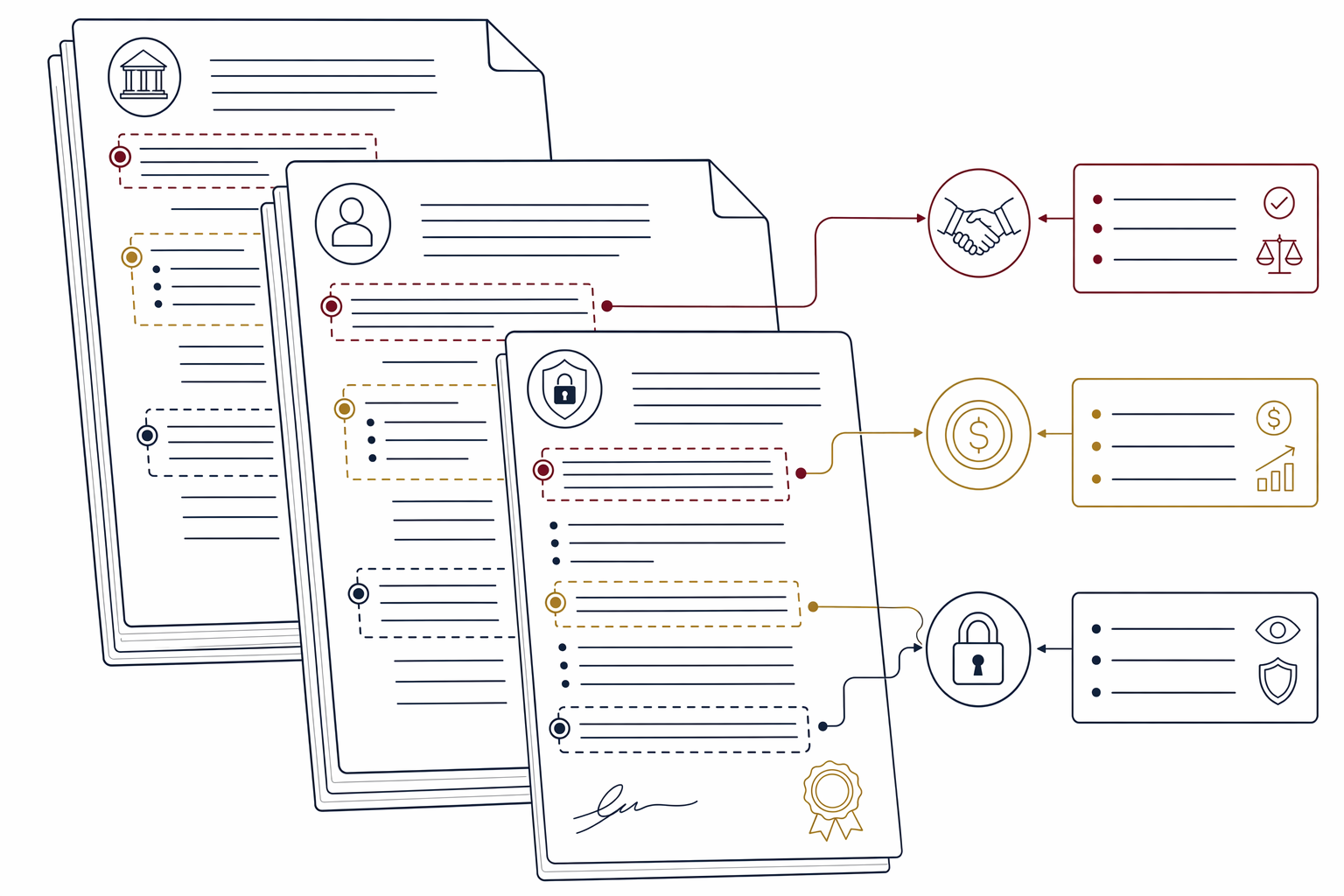
What business contracts and agreements cover
A business contract is a written agreement that explains what each side will do, when they will do it, what they will pay, and what happens if something goes wrong. This service covers common documents used by US small businesses at startup and as they grow.
Examples include:
- Operating agreement — the internal rulebook for a limited liability company, or LLC, which is a business structure that can help separate business liabilities from the owner's personal liabilities.
- NDA — a non-disclosure agreement, which is a contract that says certain information must be kept confidential.
- Client service agreements
- Vendor and supplier contracts
- Independent contractor agreements
- Website terms and policies
- Founder and partnership terms
- MSA — a master services agreement, which is a contract that sets the main legal terms for an ongoing business relationship, with project details added later in smaller work orders or statements of work.
- Purchase orders and sales terms
- Lease-related business documents
You may need this service if you are forming a new company, hiring contractors, signing with customers, sharing confidential information, bringing in a co-owner, or scaling beyond simple handshake deals. If you are still setting up the business itself, see business entity formation and our guides on how to form an LLC in the US and LLC vs. corporation.
FoundryCounsel is not a law firm and does not give legal advice. We provide general educational information and free matching to licensed attorneys.
What an attorney actually does
A licensed attorney does more than fill in a template. The work usually starts with understanding how your business actually operates: who is paying whom, what is being delivered, what deadlines matter, and where the real risk is.
An attorney may:
- Draft a new contract from scratch for your business model
- Review a contract sent by the other side and explain the practical risks in plain language
- Revise unclear or unfair terms
- Add payment terms, late fees, delivery milestones, renewal rules, and termination rights
- Clarify who owns work product, software code, designs, or other intellectual property
- Add confidentiality and non-solicitation language when appropriate
- Address dispute resolution, venue, governing law, and notice requirements
- Check whether the signer has authority to bind the company
- Make sure contracts work together with your DBA — a "doing business as" name, which is a trade name a business uses that may differ from its legal company name — and your legal entity documents
For LLC owners, an attorney may also draft or revise the operating agreement so ownership percentages, voting rights, profit distributions, management authority, buyout rules, and exit terms are clear. For partnerships and co-founders, they may also help with partnership and founder agreements.
If your contract touches compliance issues like permits, regulated services, or state filing requirements, the attorney may also flag items to verify with the Secretary of State, IRS.gov, or other official agencies. If your agreement includes tax-sensitive terms, you may also want to review what an EIN is and how to get one. An EIN is an Employer Identification Number, which is the IRS tax ID number for a business.
Typical process from first call to signed agreement
Most contract projects follow a practical sequence.
- You explain the business need in simple terms. For example: "I need a client contract for marketing services" or "A vendor sent me a 12-page agreement and I do not know what I am signing."
- The attorney identifies the document type, the timeline, and whether the job is drafting, review, negotiation support, or all three.
- You share the current draft or background facts. Use contact details and a short description when requesting a match. Do not send SSN, ITIN, EIN, immigration status, bank account numbers, or confidential business secrets through a form.
- The attorney reviews key terms such as scope, payment, ownership, liability limits, default rules, and termination.
- You receive comments, a revised draft, or a fresh draft.
- If needed, the attorney helps with redlines and negotiation with the other side.
- You finalize and sign, then store the final version in a place your business can find later.
Simple reviews may move quickly. Heavier negotiation or multi-owner agreements often take longer because the business terms need to be agreed first. If you are dealing with commercial space, a lawyer may also help with commercial leases and real estate.
Typical flat-fee ranges
Costs vary by state, lawyer, contract type, length, and urgency. These are common flat-fee ranges, not quotes.
- Basic NDA review or draft: about $200 to $800
- Simple client or contractor agreement: about $500 to $1,500
- Review of a contract provided by the other side, with written comments: about $400 to $1,500
- Operating agreement for a single-member or simple multi-member LLC: about $500 to $2,500
- MSA or vendor agreement for ongoing business relationships: about $1,000 to $3,500
- Founder, partnership, or more complex ownership agreement: about $1,500 to $5,000+
- Contract negotiation support beyond one draft: often added as a separate flat fee or hourly fee, depending on scope
Higher ranges are common when the deal is time-sensitive, heavily negotiated, industry-specific, or tied to larger financial risk. You can read more in how much does a business lawyer cost.
Be careful with anyone who gives a very low number before understanding the actual document or promises a specific outcome. No attorney can honestly guarantee that the other side will accept terms or that a dispute will never happen.
When you might do it yourself and when an attorney is worth it
Some low-risk situations can start with a simple template, but templates have limits. They may not fit your state, your industry, or the way your business really works.
You may be able to start on your own if:
- The project is low-dollar and low-risk
- You are using a simple NDA or short service agreement for a routine transaction
- No one is sharing valuable intellectual property or sensitive data
- There are no co-owner, equity, lease, or regulatory issues
An attorney is usually worth it if:
- The contract is more than a few pages or written in dense legal language
- The other side drafted the agreement
- The dollar amount matters to your cash flow
- You are giving credit, accepting deposits, or setting refund rules
- The contract affects ownership of software, branding, inventions, designs, or client data
- You are entering a partnership or changing LLC member rights
- You are signing a lease, exclusivity clause, personal guarantee, or non-compete-related term
- You want the contract to hold up better if there is a dispute later
For official business-name and entity questions, check your state's Secretary of State. For tax matters, use IRS.gov. For trademark issues, use USPTO.gov. A licensed attorney can help you apply those rules to your specific situation.
Questions to ask an attorney and how free matching works
Before hiring an attorney, ask direct questions:
- Have you handled this type of agreement before?
- Will you draft from scratch, review, or negotiate?
- What is included in the flat fee, and what would cost extra?
- How many rounds of revisions are included?
- What are the biggest risks you see in this draft?
- Which terms are market standard, and which terms are unusually one-sided?
- What turnaround time is realistic?
- Are there state-specific issues I should know about?
FoundryCounsel's how it works process is simple. Tell us your business need, state, and preferred language. We match you for free with a licensed attorney who handles this kind of work. FoundryCounsel is not a law firm, does not represent you, and does not create an attorney-client relationship. Participating attorneys pay a flat marketing fee to be part of the service.
If you want help finding the right attorney for a contract, NDA, operating agreement, or related document, start here: Get matched. You can also browse more services or guides.
An honest note
This is general educational information, not legal advice, and does not create an attorney-client relationship. Laws and fees vary by state and change over time — confirm details with a licensed attorney and official sources before you act.
If a contract affects your money, ownership, or risk, having a licensed attorney draft or review it can prevent costly mistakes.
Common questions
Do I really need an operating agreement if I have an LLC?
Often yes, especially if there is more than one owner. An operating agreement sets the internal rules for your LLC, including voting, profit sharing, management, and what happens if an owner wants to leave.
Can an attorney just review the contract the other side sent me?
Yes. Many business owners hire an attorney only for review, risk spotting, and suggested edits rather than full drafting from scratch.
How long does a contract review usually take?
A simple review may be quick, but timing depends on document length, complexity, urgency, and whether negotiation follows. Ask the attorney for a realistic turnaround before you hire them.
Are online templates good enough?
Sometimes for very simple, low-risk situations, but templates often miss state-specific rules and important business terms. If the money, relationship, or risk matters, a licensed attorney is usually worth it.
What should I send when I ask to be matched?
Send only basic contact details and a short description of the problem, such as the contract type and your state. Do not send SSN, ITIN, EIN, immigration status, bank account numbers, or confidential business secrets through a form.
Ready to talk to a business-law attorney?
Get matched, free, with licensed business attorneys in your state. You compare flat-fee quotes and choose who to hire — and you confirm the fee and scope in writing before any work starts.