Guides
What Is an EIN and How Do You Get One?
An EIN is a federal tax ID number for a business. This guide explains what an EIN (Employer Identification Number) is, when you may need one, and how to apply through the IRS for free in plain language.
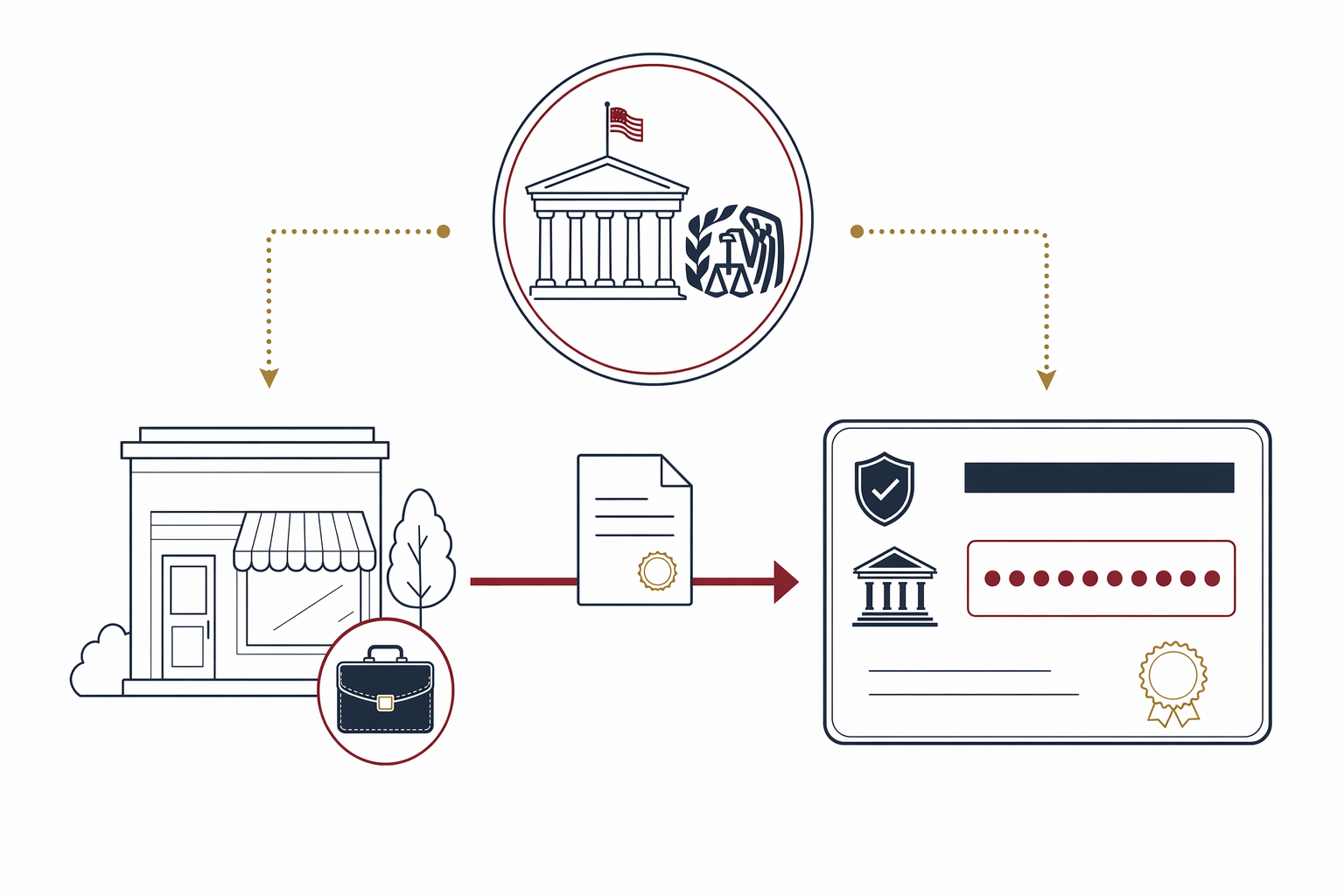
What an EIN is
An EIN (Employer Identification Number) is a nine-digit tax identification number the Internal Revenue Service, or IRS, uses to identify a business. You can think of it as the business version of an ID number for tax and reporting purposes.
Businesses often use an EIN to open a business bank account, hire employees, apply for certain licenses, and file federal tax forms. Even if your business has no employees, you may still need one depending on your business structure and how you operate.
An EIN is issued by the IRS, not by your state. For state filings, the main office is usually the Secretary of State, which is the state agency that handles business entity filings like forming an LLC or corporation.
If you are still choosing a business structure, it helps to read How to Form an LLC in the US and LLC vs. Corporation: Which Is Right?.
When a business usually needs an EIN
Many owners apply for an EIN early because banks, payment processors, and government agencies often ask for it. But not every business is required to have one on day one.
You usually need an EIN if your business:
- Has employees
- Is formed as a corporation
- Is formed as a partnership, meaning a business owned by two or more people sharing profits and responsibilities
- Files certain federal taxes, such as employment or excise taxes
- Wants to open a business bank account and the bank requires it
- Wants to apply for business credit in the business name
- Needs permits or licenses that ask for a federal tax ID
You may also want an EIN if you run a LLC (limited liability company), which is a business structure that can separate the owner's personal liability from the business's liabilities. A single-member LLC, meaning an LLC with one owner, may sometimes be able to use the owner's Social Security Number for certain federal tax purposes, but many owners still get an EIN to help separate business records from personal records.
If you plan to elect S-corp (S corporation) tax status, which is a federal tax treatment that may let some businesses split owner pay between salary and distributions, or operate as a C-corp (C corporation), which is a corporation taxed separately from its owners, an EIN is generally part of the setup process.
An EIN does not replace state or local licensing. You may still need permits, tax registrations, or industry-specific approvals. For that, check your Secretary of State, state tax agency, and local licensing office. You can also review Business Compliance and Licensing for common legal help areas.
What an EIN does and does not do
An EIN helps identify your business to the IRS. It is important, but it is not a business license, not proof that your company is properly formed, and not automatic permission to do business in every state.
An EIN also does not create a company by itself. To legally form a state entity, you usually file with the Secretary of State. For example:
- Articles of organization are the formation document used to create an LLC with the state.
- An operating agreement is the internal document that explains how an LLC is owned and managed.
- A registered agent is a person or company authorized to receive legal and government papers for the business.
- A DBA (doing business as) is a business nickname or trade name used instead of the company's legal name.
If you are forming a business, the order often looks like this:
- Choose the entity type.
- Form the company with the Secretary of State if needed.
- Get an EIN from the IRS.
- Open a business bank account.
- Apply for licenses, permits, and tax registrations.
Some businesses also need contracts early on. For example, an NDA (non-disclosure agreement) is a contract used to protect confidential information, and an MSA (master services agreement) is a main contract that sets the general terms for ongoing work between businesses. If you need help with those, see Contracts and Agreements and Partnership and Founder Agreements.
Some companies may also need to consider a BOI report (Beneficial Ownership Information report), which is a federal report that may require certain companies to disclose who owns or controls them. Rules in this area can change, so confirm current requirements with official government sources and a licensed attorney.
How to get an EIN from the IRS for free
The IRS issues EINs for free. If a website tries to charge you just to submit the IRS EIN application, understand that the IRS itself does not charge an application fee.
The main official source is IRS.gov. Use the IRS EIN application there when available for your situation. Before you start, gather basic information such as:
- The legal name of the business or owner
- The business mailing address
- The type of entity, such as sole proprietorship, LLC, partnership, or corporation
- The name of the responsible party, meaning the person who controls or owns the business
- The reason for applying, such as starting a new business or hiring employees
In general, the process looks like this:
- Go to IRS.gov and find the EIN application.
- Choose the correct entity type.
- Enter the business details exactly as they appear on your formation documents, if you formed a state entity.
- Review everything carefully before submitting.
- Save or print the IRS confirmation notice when you receive it.
Be careful with third-party websites that look official. Some charge service fees for something you can do directly with the IRS for free. Others may ask for more information than they need.
For privacy and security, do not send sensitive numbers or confidential business information through a matching form. If you want help finding a lawyer, use Get Matched with only your contact details and a short description of what you need. FoundryCounsel is not a law firm and does not provide legal advice or create an attorney-client relationship.
Common situations and examples
Here are a few simple examples of when an EIN comes up.
- A one-person online store forms an LLC in Texas. The owner gets an EIN after the LLC is approved so the owner can open a business bank account and keep business taxes and records separate.
- Two friends start a consulting company together. Because the business is a partnership, they usually need an EIN even before hiring anyone.
- A restaurant hires staff. It needs an EIN for payroll tax filings and other employment-related reporting.
- A freelancer works alone as a sole proprietor. The freelancer may not always be legally required to get an EIN right away, but a bank or client may ask for one.
In each case, the right setup depends on details like the state, the tax classification, and whether there are co-owners or employees. A lawyer or tax professional can help if the facts are not straightforward.
If you are deciding between structures, LLC vs. Corporation: Which Is Right? can help you compare the basics. If you want legal help with formation, see Business Entity Formation.
Mistakes to avoid and when to get legal help
A few mistakes cause trouble later:
- Applying before you are clear on the business structure
- Entering a legal name that does not match your state filing
- Forgetting to save the IRS EIN confirmation notice
- Thinking an EIN is the same as a license or permit
- Paying a third-party site without realizing the IRS application is free
- Using one business's EIN for a different business
You may want to speak with a licensed attorney if:
- You have multiple owners and need clear ownership terms
- You are not sure whether to form an LLC or corporation
- You are operating in more than one state
- You are bringing on investors
- You need founder, contractor, lease, or vendor agreements
- You are unsure about compliance filings or changing tax elections
Attorney costs vary by state, experience, and the scope of work. Many business lawyers charge flat fees for formation-related work, but the range depends on the state and the complexity of the business. Any cost range is only a general range, not a quote. You can learn more at How Much Does a Business Lawyer Cost?.
If you want help finding a licensed business attorney, How It Works explains the process, and you can Get Matched for free. FoundryCounsel is a free matching service, not a law firm or attorney.
An honest note
This is general educational information, not legal advice, and does not create an attorney-client relationship. Laws and fees vary by state and change over time — confirm details with a licensed attorney and official sources before you act.
An EIN is your business's federal tax ID, and many owners can get one themselves from the IRS for free if they understand when it is needed.
Common questions
Is an EIN free?
Yes. The IRS issues EINs for free through IRS.gov. If another site charges a service fee, that is the site's fee, not an IRS fee.
Do I need an EIN if I do not have employees?
Maybe. Some businesses still need an EIN because of their entity type, tax filings, bank requirements, or licensing needs, even with no employees.
Is an EIN the same as a business license?
No. An EIN is a federal tax ID from the IRS. A business license is permission from a state or local government to do certain business activities.
Can I get an EIN before I form my LLC?
That depends on your setup, but many owners first form the LLC with the Secretary of State and then apply for the EIN using the exact legal name from the state filing. If timing or structure is unclear, confirm with the IRS or a licensed attorney.
Do I need a new EIN if I change my business?
Sometimes. A major change in entity type, ownership structure, or tax classification can require a new EIN, but not every change does. Check IRS.gov for the current rules.
Should I hire a lawyer to get an EIN?
Not always. Many owners can apply directly through the IRS, but legal help can be useful if you have co-founders, are choosing between entities, or need formation and contract documents handled correctly.
Ready to talk to a business-law attorney?
Get matched, free, with licensed business attorneys in your state. You compare flat-fee quotes and choose who to hire — and you confirm the fee and scope in writing before any work starts.